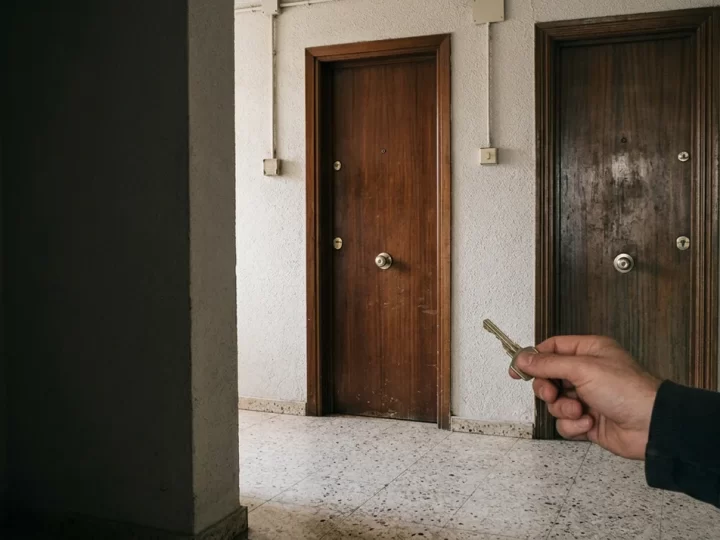
If you find a forced door or damaged lock, choosing a new cylinder is not the first decision. If someone could still be inside or you suspect a break-in, move away, do not enter, call 112 and follow police instructions. Mossos d’Esquadra advise residents not to touch anything when a forced door or window suggests a possible burglary.
Repair comes later, when the area is safe and work has been permitted. The cylinder, protective fitting, lock, strike plate and frame may all need assessment. Replacing one part too soon can disturb evidence or leave the true damage unresolved.
The first minutes are about people, not hardware
Do not go in to inspect the scene. If the door is open or shows fresh pry marks, stay back and contact police. Tell the 112 operator if someone needs urgent help. Do not touch the lock, nearby objects or tools that may have been left behind. Do not pursue or confront anyone. This order is about safety and preservation, not creating commercial urgency.
Even if the door remains shut, do not repeatedly test the key “to see whether it still works” when a crime is suspected. From a safe place, note when you discovered the damage and what you actually saw. If police ask you to wait, do not commission an immediate replacement that could alter the scene.
SAFETY FIRST
What should happen before repair?
If someone might still be inside, do not enter or confront anyone. Call 112.
Do not touch the door to use this tool. Put people and police instructions first.
Local guidance, not a police or technical diagnosis. No answers are stored or sent.
Preserve the condition until you receive instructions
A photo may help later, but do not approach or move things for a better angle. If officers allow photographs, keep the original files and avoid posting the address or security details online. Ask your insurer what records it needs, but do not put that administrative step ahead of police guidance.
If you know the damage was accidental and there is no sign of a crime, the sequence may differ. Even then, a door that no longer closes reliably needs a proper assessment. Do not force it shut for the night or confuse a temporary measure with a complete repair.
A private timeline without disturbing evidence
Use this script to keep observed facts separate from guesses. Complete it from somewhere safe; never enter or handle objects to fill a gap.
When did you find it?
Record the last time you saw the door in normal condition and the approximate discovery time. Separate what you remember personally from what somebody else told you.
What could you see without touching?
Door open or closed, visible damage to the frame or hardware, objects visible from outside and any possible person inside. Do not guess which tool was used.
Who did you contact?
Note the time of the 112 call, any instructions received and when work was authorised. These notes do not replace an official police report.
What was repaired afterwards?
Keep the quotation, invoice, removed components if preservation is requested and a description of the work. Do not edit old images to make them look like new evidence.
A proper repair looks beyond the keyhole
Force can affect the cylinder, escutcheon, lock, locking points, strike plate, frame or frame fixings. A key turning again does not establish that the door has its previous resistance. The professional should explain which parts are damaged and what is needed for reliable closure. If the frame is distorted, a new cylinder alone will not fix it. If the outside fitting is loose, its fastening also matters.
The quotation should distinguish essential repair from optional security improvements. A shiny new component or a “high security” label is no substitute for checking the entire door. Our lock repair service in Lleida concerns this technical phase. If the door is inaccessible and police permit work, an emergency opening may be necessary before repairs; these are separate jobs.
What to tell the locksmith
Say that there were signs of force and whether officers have allowed repair. Describe whether the door is open, closed or ajar; whether the key enters or turns; whether the frame looks displaced; and whether the access needs temporary securing. Do not send full key images or personal documents through an unverified channel.
Ask what will happen to removed parts. Police or an insurer may need them; do not discard them until the responsible parties advise you. Request the material reference and an explanation of what was checked. Clear records let you assess the work rather than rely only on speed.
After the door is secured
With the technician and when it is safe, check that the leaf closes without force, all locking points engage and the supplied keys work. If keys may have been taken, tell both police and the professional. Check other entrances without replacing everything blindly or overlooking visible damage.
A repair can restore use without being a full security upgrade. If you later want reinforcement, compare cylinder, escutcheon, frame and closing habits against the actual door. Our guide to protective lock fittings explains why one component alone cannot certify the assembly.
If you need a locksmith in Lleida after a suspected break-in, Serralleria Catalana can assess the closure once the safety issue is cleared. A locksmith visit never replaces the police response.
Arriving at an entrance that looks different
A suspected break-in is not always obvious. You might see a fresh gap beside the frame, a displaced outside fitting or a door that is unexpectedly ajar. You may simply notice that the key behaves differently. None of these observations proves what happened, and you do not need to establish a cause before seeking help. Stay back where you can leave easily. If an intruder may still be present, call 112, give the location and do not enter. Do not ask a neighbour to go inside on your behalf. Moving the inspection to someone else does not remove the uncertainty or the danger.
If children are with you, take them away from the entrance before making calls or trying to document the damage. Tell the 112 operator if someone who needs assistance may be inside. If you were already indoors when you noticed worrying signs, do not search the rooms or confront anyone. Leave if you can do so safely; otherwise follow emergency instructions. The first useful details are where you are, whether anyone may be at risk and what you directly observed. The model of the lock and the price of a replacement are questions for later, when the situation has been made safe.
Describe observations without reconstructing an event
“The door was ajar when I arrived” is an observation. “Someone forced this lock at noon” combines assumptions about cause and time. A mark on a frame may be important, but its appearance alone does not identify a person, tool or sequence. Tell officers when you last saw the entrance in its usual condition and when you found it changed. If those times are approximate, say so. If you have not gone inside, say that you do not yet know whether anything is missing. Clear uncertainty is better than confident detail invented under stress.
Keep separate what you saw, what a neighbour reported and what a camera or alarm notified. If a recording exists, preserve the original rather than editing a highlight into what looks like a complete account. Ask police how they want relevant material handled. Do not approach the doorway for a close-up picture unless officers say it is appropriate and it can be done safely. Do not move an item to make a photograph clearer. Avoid posting the address, entrance layout or images of keys online in search of an explanation. Public guesses about the mark can distract from the facts you can actually verify.
Why the order of calls matters
When a crime is suspected, the immediate sequence is personal safety, police guidance and then authorised repair. A locksmith is qualified to assess a mechanical problem, not to declare an uncertain scene safe for entry or evidence collection. An insurer may ask for records, but an administrative request should not prompt you to handle the door against police instructions. This separation does not prevent you from contacting relevant people; it keeps each decision with the person or service responsible for it. Record the instructions you receive and when you receive them, without interrupting urgent work to complete a form.
You may already have arranged a locksmith before officers arrive. Explain that the entrance must remain untouched until work is permitted. Tell other residents or anyone with a key the same thing, so someone does not open the door without knowing why it is being left alone. Once officers allow an intervention, confirm what may proceed and convey that limit to the professional. In some situations the immediate task may be to secure the opening, with further assessment later. In others, work may have to wait. This article cannot set a universal timetable for a particular investigation or override directions given at the scene.
What “temporarily secured” should mean
A door that appears closed may still have a damaged frame or a locking point that does not engage. After work is authorised, describe the actual problem: the leaf will not close, the key will not turn, or the closure works only with unusual force. Ask the technician to distinguish what can be restored immediately from what needs a further visit or different material. If a measure is temporary, request a clear description of its limits and the remaining work. Do not accept “all secure” as a substitute for an explanation of what was checked. A repaired entrance can be usable without being a comprehensive security upgrade.
If reliable closure cannot be restored, discuss practical arrangements for the property with the people responsible for it. Do not improvise a barrier that could prevent occupants from leaving. An emergency opening, a repair to the lock and work on a distorted frame are different tasks even if they occur on the same visit. Ask for their scopes to be identified separately. A fast response is valuable when an entrance cannot be used, but speed alone is not evidence that every affected component has been examined. Keep the initial quotation and ask for an explanation if a closer assessment changes the proposed work.
The door is a system, not a cylinder
The key operates a cylinder, but the result also depends on the lock mechanism, locking points, strike plates, hinges, leaf and frame. Damage to one area may change the alignment of another. A key can turn while the leaf rubs or one point fails to seat as intended. Conversely, a visible mark does not by itself prove that a hidden component is damaged. Ask the locksmith to identify what has been inspected and what remains uncertain. You should not dismantle parts yourself to answer that question, particularly while the scene may need to be preserved. A professional assessment needs the actual door, not just a photograph.
If the frame has moved, changing the cylinder alone may leave a poor fit. If an outside protective fitting is loose, its attachment needs attention as well. These are reasons to ask about the assembly, not a prescription to replace every component. Distinguish the work needed to restore ordinary use from optional reinforcement you might consider later. Ask whether the quotation includes materials, labour, adjustments and any return visit. A product label cannot guarantee the performance of a damaged installation. Equally, an honest statement that a part cannot yet be assessed is more useful than an absolute security promise made before the door has been examined.
A focused conversation with the locksmith
Once the police permit work, tell the professional how you found the entrance and what was observed without touching it. Was the door open, shut or ajar? Did the key enter or turn when you last used it normally? Was damage visible on the frame or outside hardware? Explain any instruction to retain removed parts and whether the property needs immediate temporary closure. Ask what the technician proposes to inspect first and why. This is not a request for a method of opening the door; it is a way to understand the scope and sequence of a service you may authorise.
Request a written distinction between a necessary repair and a suggested improvement. Where known, the description should identify replacement material and the area of the door being worked on. If additional damage becomes apparent, ask for a revised explanation before agreeing to extra work. A remote estimate may be useful for planning, but it cannot establish the complete condition of a door that has not been seen. Avoid sending full key photographs, ownership documents or personal identifiers through unverified messaging channels. If a particular document is genuinely needed, confirm who is requesting it and how it should be provided.
Check everyday operation, not resistance by force
When it is safe to use the entrance again, ask for a demonstration with the technician present. The door should close along its normal path without being lifted, slammed or pushed hard. Check the agreed keys and observe whether the locking points operate when the leaf is shut, not only when it is open. This is an ordinary function check, not a homemade test of resistance to attack. Do not pull or strike a recently repaired door to see whether it is “strong enough”. A smooth key turn proves only that the mechanism operated in the conditions tested; it does not certify the entire installation.
Have the work record say what was replaced, adjusted and left outstanding. If a removed component must be kept for police or insurer review, do not clean or discard it before receiving instructions. A photograph of the finished door may help document the result when appropriate, but it does not replace an invoice or a description of the diagnosis. If the problem recurs, note whether it happens with the door open or closed and whether it affects every supplied key. Stop forcing the mechanism and ask for reassessment. Do not assume a new difficulty is a normal after-effect of a forced-entry incident.
Keys and other people who can enter
If keys may have been taken, tell both police and the locksmith. Make a private list of who needs access after the incident: residents, an authorised owner or manager, carers and any other legitimate users. Agree how replacement keys will be issued and record where they went. A new cylinder can change which keys operate one door, but it does not repair a damaged frame or address every other entrance. Do not send complete key images or control codes to a broad group chat. Protecting access information is a separate task from restoring the lock’s mechanical function.
In an apartment building, distinguish the flat door from the common entrance, garage and storage area. Evidence of damage at one location does not prove that every shared lock has been compromised. If you see damage to a communal door, inform the building manager or other responsible person and leave any suspected incident scene untouched for police guidance. If a lost key gives access to multiple areas, explain that fact rather than assuming what must be replaced. Mossos’ home-safety guidance advises against keeping keys in outdoor hiding places. That is a general prevention point, not an explanation of this particular event.
Renters, owners and shared premises
If you rent, contact the owner or property manager after dealing with the immediate safety concern. Report observed damage and police instructions, without assigning blame or stating an unverified cause. Clarify who can approve repair work, who will meet the technician and who will receive the keys and invoice. For a shared entrance, coordinate with the building’s responsible people before authorising changes that affect other occupants. If the affected place is a workplace, tell staff discreetly which access should not be used until it has been assessed. None of these coordination steps should delay calling 112 when someone might still be inside.
Sometimes a resident, colleague or caretaker urgently needs something beyond the affected door. Their need does not cancel a direction to preserve the scene. Tell them where to wait and who is managing the incident. If a vulnerable person or animal may be inside, make that clear to emergency services rather than trying a risky entry yourself. For the subsequent repair, agree who can authorise an increase in scope and who will keep the records. A clear handover prevents two tradespeople from working on the same door without knowing which parts were already removed or changed.
Records for police and an insurer
Keep the initial timeline, police reference if one is provided, quotations, invoice and description of installed parts together but clearly dated. When officers permit you to inspect the property, prepare a list of items you can actually confirm are missing or damaged. Existing photographs, receipts, models and serial numbers may help identify belongings. The Mossos guidance linked below recommends bringing identifying details of stolen items when making a report. Leave uncertain entries marked as uncertain rather than filling gaps with an estimate presented as fact. Your private notes support recall; they are not a substitute for an official report.
Ask your insurer directly what documents it requires under your policy, whether it wants removed components retained and how it wants a repair described. Terms, deadlines and coverage cannot be established by this article or by a locksmith’s general comment. Keep copies of relevant communications and distinguish the time of discovery from the time of each intervention. If police and insurer requests appear to conflict, seek clarification before changing the scene or disposing of material. Orderly records help explain what happened and what work was done, but they do not promise a police conclusion or an insurance payment.
After the immediate incident
Restoring normal operation and improving security are separate decisions. Over the following days, notice whether the door rubs, a key needs unusual force or a gap has appeared. Describe a specific symptom to the professional rather than assuming that all later faults have the same cause. If you want a further security review, ask for the condition of the whole entrance to be considered. The leaf, frame, lock, protective fitting and daily closing habits each matter in different ways. Repair documented damage first; then compare optional proposals without the pressure of needing the door shut that same evening.
The timeline you wrote before any work can help with a later opinion. Show what was visible initially, which components were changed and what difficulty remains. Mark observations confirmed afterwards as later findings, not as things you knew at the start. A photograph cannot reveal every condition behind a fitting, and an invoice cannot prove that no other damage exists. If new signs of interference appear or you again think somebody may be inside, return to the safety sequence: move away, do not enter or disturb the area, and call 112. If the issue is solely a closure fault with no immediate danger, contact an authorised repair professional and avoid forcing the mechanism.
Making a useful handover without overstating certainty
Different people may become involved over several days: the resident who discovered the damage, officers, a property manager, an insurer and one or more repair professionals. Give each person the part of the record relevant to their role. The next technician needs to know what the first one replaced and which symptom remains; they do not need an invented story about how the damage was caused. A manager needs to know which entrance can be used and whether further work is proposed. Keep private identifiers and key details out of messages sent to a wide audience. A short, accurate handover helps everyone act without turning guesses into established facts.
If you later realise that a time, description or item list was wrong, correct it openly and retain the earlier note rather than silently rewriting history. Explain whether the correction came from a receipt, a photograph, another witness or your own later inspection. That is especially helpful when the door has changed between the first observation and the final repair. Separate a temporary closure, a permanent repair and an optional improvement on invoices and in your own notes. They answer different questions and may have happened on different dates. No single document establishes what occurred in every detail.
There is no need to choose between taking safety seriously and avoiding unnecessary work. You can insist on leaving a possible crime scene untouched, then ask precise questions about the repair once police permit it. You can request a usable door without treating every sales recommendation as essential. And you can keep records for an insurer without assuming that a particular claim will be accepted. If uncertainty remains about who may be inside, stop the technical discussion and call 112. If the danger has passed, an authorised professional can examine the actual assembly and explain the choices in writing.
Have police said work may proceed? Tell us what damage is visible and how the door currently closes. If danger or suspected crime remains, call 112 first.
Safety and preservation: Mossos d’Esquadra home-safety advice. Follow officers’ instructions in the individual case.
Reviewed content
Professional experience behind this guide
Serralleria Catalana reviews this content against real work with openings, locks, cylinders, doors and safes in Lleida. When price depends on the door, time, hardware or diagnosis, we explain that before giving a fixed figure.
- Published
- 17/11/2026
- Updated
- 11/11/2026
- Reviewed by
- Serralleria Catalana
- Standard
- Local experience, proportionate security and clear pricing.

Professional locksmith in Lleida with over 25 years of experience. I write to help you protect your home wisely — no jargon, no fear.