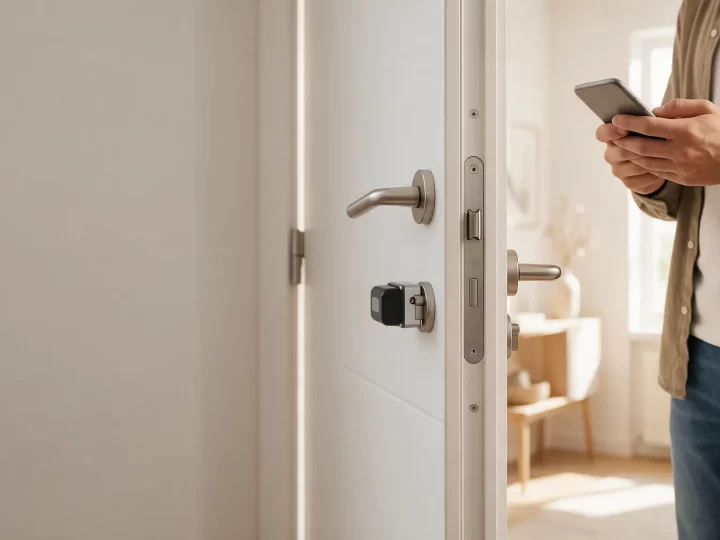
Changing a door lock does not always mean replacing the entire lock. Many doors with a Euro-profile cylinder only need a compatible cylinder. In other cases the problem lies in the lock case, multipoint mechanism, protective fitting or door alignment. Start with the door open, identify the hardware and test its operation without force.
Before buying a replacement, identify which part is failing and whether a cylinder change would actually solve the problem. The steps below assume an open door and cannot be used to regain access to a locked one. If the door is shut and you cannot get in, do not attempt the removal sequence. Call 112 if someone is in immediate danger.
DECIDE BEFORE DISMANTLING
Which change makes sense?
Three facts to prepare a decision; this cannot open a door or confirm a fit.
Choose only what you already know. This aid cannot replace a model data sheet.
Answers stay in this browser; nothing is stored or sent.
A cylinder is not the whole lock
The cylinder accepts the key and transfers its movement. The lock case moves the latch or bolts. On a multipoint door, several locking points must operate together. A stiff key can be a sign that the door is misaligned with its frame rather than a faulty cylinder. Replacing the most visible part before finding the cause can leave the original problem untouched.
With the door open, look at its edge. If a retaining screw sits level with the cylinder and the mechanism is a conventional Euro-profile assembly, changing just the cylinder may be possible. Lever locks, certain security doors and electronic systems can require quite different procedures. A video of another door cannot establish that yours uses the same hardware.
Your reason for replacement matters as much as the part. A lost key is a key-control issue. A jam is a diagnostic issue. A security upgrade requires a review of the door, frame, cylinder and exterior protection. Buying an entire mechanism when a cylinder would suffice can be wasteful; buying a cylinder when the lock case has failed does not fix the door.
Let the symptom identify the part to investigate
Separate three checks before ordering anything. Does the key enter and turn? With the door open, does the mechanism move its latch and bolts? When the leaf meets the frame, does it latch without extra force? These questions test different parts of the assembly. A good answer to the first does not prove the lock case is sound; a bad answer to the last does not condemn the cylinder. Keep an alternative route available while testing.
If a key has gone missing but the door still works, the main issue is who can enter. An independent Euro-profile cylinder may allow the old key to be invalidated. First check whether there are other key holders, a shared entrance or a master-key arrangement. A replacement can solve the immediate concern only if the new copies are issued deliberately and everybody who needs legitimate access can still obtain it.
If the key is stiff even with the door open, note where resistance starts and whether the handle changes it. The cylinder, lock case or their connection could be involved. Do not start by drilling, forcing the key or spraying an arbitrary product into the mechanism. Those actions can hide the evidence or damage a part that could otherwise be examined. If the key turns freely but the bolts do not move, the cylinder’s length is unlikely to be the whole explanation.
If everything operates freely while open but binds as the leaf reaches the frame, look at the strike positions and any contact between bolts and keepers. A dropped door, compressed seal or shifted strike can make a sound lock feel broken. Buying a new cylinder will not remove the load that the frame is imposing on the locking points. Record whether you must lift the handle, push the leaf or lean on it to close.
A fault on one side only is another useful clue. Check whether a key has been left inside and whether the model is designed for outside operation in that situation. If performance has changed, describe which side, which movement and whether the door is open or shut. Do not keep repeating a difficult turn until the key bends.
When a simple change is worth considering
The clearest case is a door you are entitled to modify, held open and supervised, with an identifiable Euro-profile cylinder, a working old key, known inside and outside dimensions and the instructions for an exact replacement. In rented accommodation, a master-keyed building or a shared entrance, check who must authorize the change and who controls the keys first.
Stop if the key bends, the cylinder will not slide out gently after its correct fixing screw has been removed, the replacement will not enter smoothly, or the lock misbehaves even with the door open. Resistance is a clue, not permission to apply more force. Never close the door to test a part before confirming its full travel and operation on both sides while open.
Authorization is part of the decision. In a rented home, establish who needs a copy and what the tenancy arrangement permits. For a communal entrance, consult the person responsible for access. At a workplace, a seemingly individual cylinder may belong to a wider master-key system. A hardware change that strands another authorized user is not a successful repair.
Stop too if the door has a function you cannot assess visually: an escape route, fire protection, an electronic access system or a documented security assembly. Altering the fitting might change those functions. The responsible building manager and the manufacturer’s instructions determine what may be changed. This household guide cannot turn a specialized door into a conventional Euro-profile installation.
Finally, make sure the leaf will remain open for the whole check. A draught, an automatic closer or somebody moving the door can turn a careful test into a lockout. Clear the work area and tell other users the door is being checked. Protecting access is more important than finishing quickly.
A useful rule: identify the brand and model, photograph only the fitting and door edge while open, and compare the replacement’s specification. Do not share complete key photographs, ownership cards, codes or your home address.
Two measurements matter more than the total length
A Euro-profile size such as 35/40 mm describes the distance from the centre of the retaining screw to each cylinder end. A 35/40 and a 40/35 have the same total length but place the screw centre differently relative to the outer face. Account for the escutcheon or security fitting, a thumbturn if present, and how far the outer cylinder will project when installed.
Our separate guide on measuring a Euro-profile cylinder explains the reference point and records both sides. Measurement alone cannot confirm compatibility: cam, profile, fitting and final operation matter too. ABUS illustrates the retaining screw and two dimensions in its installation guidance; the instructions for your exact model remain decisive.
Choose a compatible replacement, not merely a similar-looking one
Before buying, record the readable make and model, the distance from the retaining screw centre to each end, which side faces outside and what fitting covers the cylinder. A photograph of the edge and escutcheon can help identify the assembly. A complete photograph of the key can expose information useful for duplication and is not necessary for diagnosing a door. Keep ownership cards and codes out of shared images too.
Two cylinders with the same overall length may put the screw centre in opposite positions. An outer security fitting also changes how far a cylinder projects once installed. One that extends too far may be exposed; one that sits too deep may not work as designed with the key and fitting. The door and its hardware, not a single number from a catalogue, decide whether the fit is right.
Euro-profile names a common shape, not universal interchangeability. The cam, an internal thumbturn, a double-clutch function and any electronic coupling may determine what can replace the old part. A multipoint door or proprietary shield may change access to the fixing screw. If you cannot identify the model, have the assembly checked rather than assuming a cylinder with matching dimensions will behave the same way.
For a security improvement, ask what the precise model actually declares and under which test or standard. Labels such as “anti-bumping” and “high security” do not on their own explain the condition of the case, escutcheon, door leaf and frame. A well-specified cylinder may be a sensible upgrade without making the complete door a certified security door. Do not infer a rating from colour, weight or price.
Key management deserves the same attention as the part. How many keys are supplied, how are authorized duplicates ordered, and does the system require an ownership card? If one key must work several doors, keyed-alike or master-keyed arrangements need planning before installation. When the reason for replacement is a missing key, check that the selected arrangement really stops that old key working.
An outline for a conventional Euro-profile cylinder
1. Make access safe. Only work on a door you are authorized to alter. Hold it open against draughts and keep the new cylinder, its keys, the appropriate screw and the manufacturer’s instructions at hand. Do not dismantle a protective escutcheon without knowing how it is fixed.
2. Check the original operation. With the leaf open, turn the key and watch whether the locking parts extend and retract freely. Use the handle if the system requires it. If the mechanism is already stiff with the door open, note that symptom before touching anything: a cylinder replacement might not cure it.
3. Remove the cylinder’s fixing screw. On a common Euro-profile assembly it is on the door edge, level with the cylinder. Keep it safe. Do not confuse it with hinge, strike-plate or lock-case screws. Use a well-fitting tool and follow the model’s instructions.
4. Align the cam with the key. On many models a slight key turn lets the old cylinder slide out. The exact position is model-specific. If it catches, check the screw and fitting again; do not lever it out or strike the door. Specialized systems may need another sequence altogether.
5. Fit and test while the door remains open. Insert the replacement gently and secure it without using the screw to pull a misaligned cylinder into place. Test key, handle and bolts several times from both sides. Check whether a key left inside affects outside operation on the selected model.
6. Check actual closure last. Once every open-door test passes, verify with someone inside and a controlled way back in that the leaf aligns and latches without pushing or lifting the handle forcefully. If it only fails when closed, look at the frame, strike and door alignment rather than forcing the new key.
This outline does not replace the manufacturer’s instructions and does not cover lever locks, unusual multipoint assemblies, proprietary security doors or electronics. If you cannot identify the system, a professional inspection is safer than guessing.
Test the finished door without risking a lockout
Start on both sides with the leaf fully open. The key should enter and come out normally, each turn should complete its travel, and all locking points should extend and retract as intended. If the design requires you to lift the handle first, do so according to the model instructions. A turn that works only when you bend the key, press the cylinder or pull the leaf is not a passing test.
Check the inside arrangement as well: key or thumbturn, handle movement and whether the exterior can still be operated while a key is left inside. That last feature varies by model. If it differs from the previous lock, explain the change to everyone who uses the entrance. A correctly fitted cylinder is not a good handover when a user reasonably expects a recovery method that no longer exists.
Only after these open-door checks should you bring the leaf to the frame. Keep a person inside or a dependable alternative route available. Verify that the latch engages, the bolts reach their keepers and both sides still unlock without pushing or lifting the door. Try from a normal opening position, not just with the leaf pressed tightly into place. A different result when shut points to alignment or load, even if the new cylinder is correctly installed.
At handover, count the new keys, decide who receives each copy and store any ownership card separately. If a screw was damaged, a component remained unused or metal fragments appeared, do not dismiss the evidence. Keep the old cylinder until the new assembly has been checked and any problem documented, then dispose of it without leaving the old keys near the entrance.
What to tell a locksmith before requesting a quote
Begin with the reason for the work: lost key, mechanical fault or security improvement. Say whether the door is open, whether anybody is inside, whether it is a home, business or shared entrance, and what happens with the leaf open versus closed. That is more useful than ordering a “better cylinder” without knowing the cause. A planned replacement and an urgent opening are different jobs.
When safe, provide the make, model, two measurements and photographs of the door edge and fittings. Do not send complete keys, codes, ownership cards or another person’s details. Ask which parts will be inspected, what the proposed material includes and which tests will be carried out afterward. A labour price for a standard cylinder may not include a special shield, damaged lock case or unexpected door repair.
Ask the professional to connect the proposed solution to your original problem. For a missing key, the outcome is control over copies. For a jam, the outcome is repeatable operation without force. For a security upgrade, it is a documented improvement to the assembly. These are different scopes; a clear explanation lets you compare quotes for the work actually required.
Common mistakes and what they reveal
- Buying by total length alone: the inside/outside split and external fitting still matter.
- Closing the door too early: test the entire movement while open first.
- Forcing a reluctant replacement: identify the mismatch or obstruction instead.
- Ignoring the frame and lock case: a rubbing door can remain stiff with a new cylinder.
- Forgetting why you changed it: after a lost key, verify how the new copies will be controlled.
Three motives, three different decisions
You lost a key, but the door works normally
A compatible cylinder change may make the lost key useless without replacing the entire lock. Do not claim a whole new case is inherently safer without assessing the assembly. Keep any ownership card separate from the keys.
The key is stiff or the door catches
Compare operation with the door open and shut. If resistance appears only when the leaf meets the frame, misalignment may be involved. Our guide to a front door that will not close properly helps describe that symptom without filing components blindly.
You want better protection
The cylinder’s data sheet, its relationship to the escutcheon, the lock case and the frame form a system. Do not assume one component has a certification just because another product of the same brand does. Ask for the exact reference and the performance declared for that installation.
When the lock is only one part of the decision
On a reinforced security door, the manufacturer may have designed the case, protective fitting and leaf to work together. Seeing a cylinder on the front does not mean a generic replacement will preserve that configuration. Find the model and consult its instructions. If a proposed part requires drilling the door leaf, cutting a plate or removing protection simply to make it fit, this is no longer a straightforward household cylinder change.
On a multipoint door, one misaligned locking point can transmit resistance all the way back to the key. Observe each bolt while the leaf is open, keeping hands clear of the moving parts. If one moves late, fails to retract or only engages when you push the door, investigate the whole assembly. A new cylinder cannot straighten a connecting rod or a shifted frame.
On an electronically operated door, the mechanical cylinder may be the backup when power or connectivity fails. A replacement that fits physically may still interfere with that recovery route or require a configuration step. Testing the app alone is not enough: check the documented offline, low-battery and authorized-user scenarios without exposing access codes or permissions in screenshots.
A protective escutcheon may hide fasteners or have its own removal order. Do not pull it off merely because it obscures the cylinder screw. Refitting it incorrectly can make key entry difficult, expose more of the cylinder or obstruct handle movement. Identifying its reference before disassembly is usually faster than repairing damage afterward.
If you cannot tell which arrangement you have, describe the door type, visible manufacturer, edge and exterior fitting, and the exact point of failure. A photograph cannot always reveal the internal case or the condition of the frame. An honest response may be that the door needs to be seen in person. A part recommendation based only on the apparent colour and size would be guesswork.
Questions to settle before closing the door
Must I replace the escutcheon too?
Not necessarily. Assess its condition and its fit with the new cylinder. A decorative rose is not automatically a security fitting, and a new fitting cannot repair a broken lock case.
Can I keep the same key?
It depends on the system. Some manufacturers offer keyed-alike or master-keyed options; a standard new cylinder usually comes with new keys. If a key was lost, make sure the chosen arrangement actually prevents that key from working.
How long should it take?
A straightforward case with access and the correct part can be brief, but unusual fittings, damaged screws and a misaligned door change the work. A reliable final test is more valuable than a universal promise of minutes.
What should I do with the old cylinder and keys?
Keep them until the replacement has been properly tested and any problem recorded. If the reason for changing was a lost key, reinstalling the old cylinder would restore that risk. When no longer needed, ask about local metal and component recycling; do not leave old keys, ownership cards or identifying photographs beside the entrance.
When does this become urgent?
If somebody cannot leave safely, a vulnerable person is inside or the lock prevents an immediate essential action, explain the situation when calling for help. The sequence above starts with an open door and controlled access; it is not an emergency opening procedure. Call emergency services when people are in danger. For a less urgent fault, keeping the leaf open and describing the symptom allows a measured replacement rather than an improvised lockout.
Is a thumbturn the same as an emergency function?
No. A thumbturn changes how the inside is operated; the ability to unlock from outside while a key is left inside is a separate feature on models that provide it. Neither feature is a substitute for checking escape requirements on a particular door. Read the product specification and try the documented behavior under controlled conditions before relying on it. In a shared home, make sure every user understands which side can be opened and how a failed key or low battery would be handled.
Identify the part before buying it and keep the door accessible throughout the work. If the replacement does not fit or the mechanism catches, describe the case. Our lock replacement service in Lleida can assess the whole assembly.
Reviewed content
Professional experience behind this guide
Serralleria Catalana reviews this content against real work with openings, locks, cylinders, doors and safes in Lleida. When price depends on the door, time, hardware or diagnosis, we explain that before giving a fixed figure.
- Published
- 29/10/2026
- Updated
- 29/10/2026
- Reviewed by
- Serralleria Catalana
- Standard
- Local experience, proportionate security and clear pricing.

Professional locksmith in Lleida with over 25 years of experience. I write to help you protect your home wisely — no jargon, no fear.