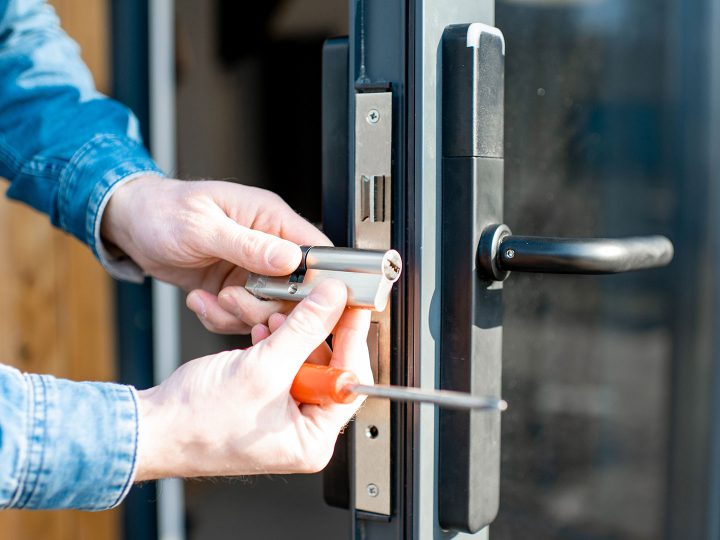
The best smart lock is the one that fits your actual door and the people who use it. More app features cannot repair a stiff cylinder, a misaligned door or an access plan that nobody understands. Start with the lock you have. Decide what you want to improve, then work out how everyone will get in when a phone, battery or connection fails.
This guide compares purchasing criteria for a European entrance door. It is not a hands-on laboratory test or a certification of any model’s physical security. Features vary by version, accessory, firmware and region. Check the current instructions for the precise device and cylinder you intend to use. If the door is locked, mechanically faulty or part of an escape route, do not alter it on the strength of a general article.
FIT CHECK
Examine the door before choosing a model
Three answers to avoid a premature purchase. This does not certify fit or recommend a brand.
Identify the lock and mechanical fallback first. Compare features and prices afterwards.
Local assessment only. Answers are not stored or sent.
There is no winner until you have measured the door
A universal ranking combines unrelated needs. One household wants convenient entry with shopping in both hands. Another needs temporary access for a relative. A third wants the front door to participate in an existing smart-home system. The first may prize a reversible installation; the second needs permissions that can be withdrawn; the third needs confirmed protocols and controllers. None of those preferences proves that the attractive motor can operate the lock already in the door.
Think in three layers. Mechanics means cylinder, lock case, protective fitting, door leaf and frame. Electronics means the motor, its power supply, sensors and communication. Administration means who can enter, who can revoke an invitation and what happens when a phone or network is unavailable. A good purchase needs all three layers to work together. A polished app does not make an overloaded multipoint mechanism turn smoothly.
The first test is a gate, not a score: can this model be fitted in accordance with its manual without making normal door use worse? If you cannot answer, a star rating cannot answer for you. With the door open, photograph its edge and inside hardware, identify the lock and measure available clearances. Do not share full key profiles, property cards or access codes in a public request for advice. The information needed to choose a product should not expose the information needed to copy a key.
Check the existing hardware before comparing features
Open the leaf and operate the key and handle. Some multipoint doors require the handle to be lifted before locking; some users need a motor that can also retract the latch. If movement is stiff while the door is open, diagnose that problem before installing a motor. If it is easy open but hard against the frame, check alignment and keeps. Our guide to a front door that will not close properly explains why those two tests point to different repairs.
Identify the cylinder profile, its inside end and the space around it. A retrofit motor may turn an existing cylinder; another design may supply its own cylinder or need a specified adapter. Similar-looking cases do not establish interchangeability. Use the exact manufacturer’s compatibility guide to check door swing, distance to frame and handle, escutcheon geometry and motor projection. A mounting template that fails to fit is a reason to stop, not a cue to drill somewhere else.
The cylinder’s emergency function deserves a deliberate test. With the leaf open and another person present, check whether a key can unlock from outside when another key remains inserted inside. Many inside-mounted retrofit motors hold or turn that inside key. If your cylinder blocks the outside side in this situation, you may lose the very mechanical fallback you expected to keep. The answer could be an appropriate double-clutch cylinder, a manufacturer-approved adapter or a different product architecture; it depends on the whole installation.
Do not stop at “Euro profile”. There are cylinders with interior knobs, special cams or gears, protective plates that restrict access, frames very close to the motor and doors opening outward. A rented home raises permission and key-custody questions. A communal, fire-rated or access-controlled door may have documented restrictions that household instructions do not cover. A solution suited to an individually owned flat is not automatically suitable for a shared entrance or a protected escape door.
Three product families, three different trade-offs
An inside retrofit over the current cylinder may retain most of the existing hardware. Its simplicity is conditional: the cylinder, mounting method, free space, turning load and outside-key operation must all suit the specific unit. Tedee GO2 illustrates this family. Tedee’s manual requires a compatible European cylinder with an emergency function or an approved adapter. “Keep your lock” is not the same as “works with every lock”. Check the exact variant rather than taking a product photograph as evidence of fit.
A motor supplied with a particular cylinder offers a set designed to work together, but it requires more careful geometry and a cylinder change. Nuki publishes a compatibility guide for Smart Lock Ultra that specifies measurements and clearances according to door swing. A supplied cylinder does not waive the need to measure your door, fitting and frame. Nor does an Ultra guide define the requirements for a differently named Nuki product. Compare model numbers, not only a familiar brand.
A motor-and-keypad kit with ecosystem features adds an entry route for someone without a phone, plus possible smart-home connections. Aqara’s U200 manual describes Euro-profile cylinder conditions and Matter-over-Thread requirements. A keypad may genuinely help a household; it also means another powered component and another set of codes to administer. Establish which function matters to you, then see what extra controller or hub it requires. Do not buy additional complexity simply because the box lists many possibilities.
None of these families is automatically more resistant to forced entry. The cylinder, protective fitting, case, leaf, frame and quality of installation still determine physical performance. A motor can automate a weak existing lock without strengthening it. If physical protection is the main concern, review that assembly first. Our guide to types of door locks for the home
How to compare Nuki, Tedee and Aqara fairly
For Nuki Smart Lock Ultra, start with the official fit guide. Nuki specifies inside and outside measurements from the cylinder retaining screw and clearances to the frame and handle that differ with the direction of opening. Those are requirements of the Ultra described in that guide, not universal numbers for all Nuki locks. If your door falls outside them, pressing the motor against the frame will not improve compatibility. Check documented alternatives or exclude that exact model.
For Tedee GO2, the distinctive question concerns the cylinder already installed. The manufacturer’s documentation specifies an emergency-function cylinder or a compatible adapter. It also distinguishes the ordinary GO2 from a GO2 Z-Wave variant with a different integration approach. Closely related names and similar photographs can hide important differences. Confirm the complete model name, package contents and intended connection method rather than borrowing a feature from another version’s page.
For Aqara U200, examine the motor, keypad and controller as a system. Aqara’s manual sets conditions for certain Euro-profile cylinders and explains Matter over Thread. Remote operation and automations may need a compatible hub and platform in the actual home. A Matter logo does not, by itself, promise access from anywhere. Verify the desired function, required accessories and region before assigning it a place in the decision. More entry methods are useful only when their owners understand how they work.
These examples are comparison exercises, not a podium. Product lines change and the same brand may sell models with different fit and connectivity. Our focused Nuki guide examines one line in more detail; the Tedee article serves another. The purpose here is earlier in the decision: determine what kind of system your door and household can use, even if the brand you eventually choose is not mentioned.
Plan for a flat battery, a lost phone and an offline home
Real reliability is tested on an ordinary inconvenient day. Ask how entry works when the phone runs out, when the motor battery is empty, when Wi-Fi disappears, when a remote service cannot be reached or when an update fails. These are different failures. A keypad may solve a dead phone but not a jammed lock case. A key may solve a network outage but only if the outside cylinder remains usable. Write down the fallback for each realistic problem rather than relying on the word “backup”.
Where the design includes a mechanical entry route, keep it operative and test it both before and after installation. If the cylinder changes, account for all new keys and property documentation. Do not store the sole spare key where it is impossible to reach from outside. In a shared home, agree who can intervene if the electronics fail without having to use the primary account holder’s phone. A fallback is useful only when the people who need it can actually perform it.
Published battery-life estimates depend on use, temperature, features and the force needed to turn the mechanism. Compare cell type, charging or replacement process and low-power warnings. A motor fighting a misaligned multipoint lock may consume more power and experience unnecessary wear. If autonomy disappoints, inspect the door as well as the device. A mechanical defect should not be hidden inside a digital troubleshooting menu where it can quietly become a more serious access problem.
Draw the dependency chain: motor, phone, local network, bridge, cloud service, keypad and mechanical key. Some actions work beside the door without internet; others need an additional controller or account. “Has Wi-Fi” does not tell you how permission is granted or what happens if the service is down. If you cannot describe the chain to another resident in a minute, the installation is not yet operationally clear. Simplicity in an emergency is a measurable feature, not just an aesthetic preference.
Sharing access without giving away control
A digital invitation can be easier to withdraw than a metal key, but only if someone understands the administration. Who can invite users? Who can revoke them? What happens when a person changes phone, loses an account or moves out? Can an invitation expire, and does the guest need an app or a bridge? Are logs available offline? Answers vary by model and accessory. The generic phrase “smart access” is not an adequate specification for a family or business.
Avoid one shared login for everyone. Individual credentials make it easier to remove one person’s access without affecting others. If you use temporary codes, define when they expire and who may pass them on. Do not treat a digital “unlocked” event as definitive proof that a particular person physically entered: it may show a command or motor action. Separate electronic events from observed events before relying on a history screen to settle a dispute.
Privacy belongs in the purchasing decision. Read what activity the app collects, how long it keeps it and how to delete or export records. Check update support for the exact model. Protect phones and accounts with unique passwords and strong authentication where supported. Never post a screenshot containing home address, entry code, user names or installation identifiers when seeking advice. Connected entry deserves the same restraint as any account capable of granting physical access.
Communal and commercial doors require clearer governance than a private door. Decide who approves new users, how a departing staff member is removed and how the administrator role is transferred. A common entrance may have fire, escape, maintenance or insurance requirements. Speak to the party responsible before altering it. One resident’s convenience cannot leave neighbours with an unfamiliar or unreliable exit. A feature advertised for a single household does not automatically scale to shared property.
Physical and digital security are related, not identical
Physical resistance comes from the specified cylinder, escutcheon, lock case, frame and installation. A smart motor does not replace those elements. If you change the cylinder to fit a device, compare its documented performance and its projection with what was there. A cylinder left exposed outside may introduce a vulnerability; one that is too short can interfere with proper key operation. Adding electronics should not degrade the underlying lock assembly in order to gain convenience.
Digital security concerns software support, accounts, permissions, communication and recovery. It cannot be judged by counting Bluetooth, Wi-Fi or Matter icons. Look for public manufacturer documentation and a clear procedure for lost phones and account transfer. It would be irresponsible to promise that any connected lock is “unhackable”; it would also be simplistic to reject all connected locks without examining the actual design. Consider realistic threats for the household and avoid a single point of failure.
Motor rotation is not identical to a properly closed door. A device might report completion while the latch has not seated or the multipoint bolts have failed to engage. Some systems support door sensors, but those need placement and calibration according to the manufacturer. Verify the physical action with the leaf in the frame. The app’s notification is useful when it reflects what the door has actually done; it should not become a substitute for checking a door that is visibly ajar.
One successful opening is not an acceptance test. With the door open, test permitted operations; then repeat during normal use with someone able to assist from both sides. Check phone entry, outside mechanical fallback, handle and manual locking. Compare a merely pulled-to door with one fully locked. If either the key or the motor must force the door against the frame, stop. That resistance is not an intelligent-lock feature. It is a mechanical issue that needs attention before automation can be considered reliable.
A short specification sheet that prevents a bad purchase
Record geometry: cylinder type and visible reference, swing direction, measurements from the retaining screw, distance to handle and frame, protective plate and number of key turns. Record operation: whether the handle must be lifted, whether the key retracts the latch, whether movement is smooth with the leaf open, and whether an outside key works with a key inside. An unknown measurement is a reason to pause, not permission to pick the smallest-looking motor.
Next record the people. Who needs to enter? Who cannot or will not use a smartphone? Who will manage temporary permissions and low-battery alerts? A keypad may answer a genuine need or add needless complexity. If older people or children use the entrance, test the ergonomics of the inside control, fallback key and handle. An elegant app cannot compensate for an exit that a resident finds confusing. Make the procedure understandable to someone who was not involved in buying the device.
Finally record total cost: motor, appropriate cylinder or adapter, keypad, bridge or controller, installation, power and maintenance. A price for a bare motor is not comparable with a package containing everything required for the intended feature. Prices change, so request a complete list for the exact configuration rather than relying on a universal figure. Check product references in an offer: similar names can represent different generations, different accessories and different fit requirements.
Choose only when these columns align. If the door is mechanically unreliable, repair that first. If the door fits but the permissions you need are absent, seek a different configuration. If the electronics are attractive but nobody knows the fallback, finish the access plan before installation. The best next step may be a motor, a different cylinder, an adjustment to the door or no smart lock at all. A responsible comparison has room for “not yet”.
Installation and handover: what should be demonstrated
Follow the manual for the exact purchased version and begin with the leaf open. If replacing the cylinder, verify both side measurements, orientation and outside function. If an adapter is required, use one the manufacturer specifies, not a lookalike. Do not drill or reshape the door to force a part into place. An installation marketed as reversible is only truly reversible when normal key use and the door structure have not been damaged.
Set up named users with the least access they need. Update firmware where appropriate and explain phone-free entry to everyone concerned. Perform initial tests with the leaf open and people on both sides. Then test the door against its frame, the handle and fallback key. Do not declare the job complete after tapping a single app button. The final configuration should be repeatable, safe and understandable to a resident who did not watch the installation.
If the outside key stops working with a key inside, do not dismiss it as a minor limitation. If calibration fails, inspect measurements and friction before repeating cycles. The motor should not “train” a hard lock by forcing it again and again. Keep a safe alternative entry while testing in case the leaf closes unexpectedly. If observed behaviour differs from the manufacturer’s instructions, stop and investigate rather than building a workaround into an everyday access routine.
At handover, note the model and reference, components replaced, account administrators, location of mechanical spares and expiry of temporary invitations. Store property documentation securely, separate from a key. Agree who receives battery alerts and how a lost phone is revoked. A useful smart lock is not simply one that opens today; it is one that residents can still manage six months later, without depending on the person who first configured it.
Questions worth answering before you decide
Will any smart lock fit a reinforced door?
No. The material of the leaf does not identify its cylinder or operating load. Check the actual mechanism, available inside space, handle movement and published fit conditions. A multipoint door may need a step that a particular motor cannot perform. Where the door is part of a certified assembly, changes must respect the relevant instructions. A photo of a similar-looking front door in an advertisement is not evidence of compatibility with yours.
Do I need Wi-Fi to unlock?
That depends on the product and on where you are. Local operation beside the door may work through one connection while remote control needs a bridge, controller and network. Separate “unlock while standing nearby”, “unlock from another city” and “send someone an invitation”. They are not the same feature. Read the exact model’s connection diagram and test a practical fallback. A loss of internet should not be the first time a household discovers how its front door works.
Does a smart lock replace a good mechanical cylinder?
Not necessarily. Some devices turn the existing cylinder; others replace it with a compatible one. Physical security still depends on the assembly. A loose protective fitting or badly protruding cylinder will not be improved by an app. If resistance to forced entry is the primary aim, review documented mechanical performance first. Then decide whether an electronic layer offers convenience that justifies its own upkeep and account management.
What about rented or shared accommodation?
Choose a configuration that is authorised, mechanically compatible and clear about who owns the administrator account and physical keys. “Reversible” does not automatically mean the tenancy permits a lock change. Plan how permissions will be removed when occupants change and how the legitimate holder will retain access. Avoid tying an entire household’s entry to a personal phone belonging to someone who may no longer administer the property.
What if the app says locked but the door is ajar?
Treat it as a real closing failure, not a cosmetic app error. From a safe position inspect the leaf, latch, multipoint bolts and any door sensor. Check alignment and calibration in accordance with the manual. Do not turn on automatic locking to disguise a door that does not meet its frame. If the failure persists, disable automation and seek an inspection before trusting a digital confirmation again.
Should I fit a motor to a door that already rubs?
No, address the rubbing first. Compare key movement with the leaf open and closed, observe where bolts meet the keeps and note when resistance appears. A motor should not overcome a load that a person already feels. Repairing alignment may be more valuable than adding a new accessory. Once the door runs smoothly, you can judge the smart device’s operation and battery life against a normal baseline rather than against a hidden mechanical fault.
Choose with your own door in front of you, not from a star chart. If the cylinder or outside-key function is uncertain, examine the mechanical lock before purchasing. Our lock replacement service in Lleida can help assess the assembly and a usable fallback without pretending that one model suits every entrance.
Reviewed content
Professional experience behind this guide
Serralleria Catalana reviews this content against real work with openings, locks, cylinders, doors and safes in Lleida. When price depends on the door, time, hardware or diagnosis, we explain that before giving a fixed figure.
- Published
- 29/10/2026
- Updated
- 29/10/2026
- Reviewed by
- Serralleria Catalana
- Standard
- Local experience, proportionate security and clear pricing.

Professional locksmith in Lleida with over 25 years of experience. I write to help you protect your home wisely — no jargon, no fear.